Trapani and the Egadi Islands: The Quietest Week in Sicily
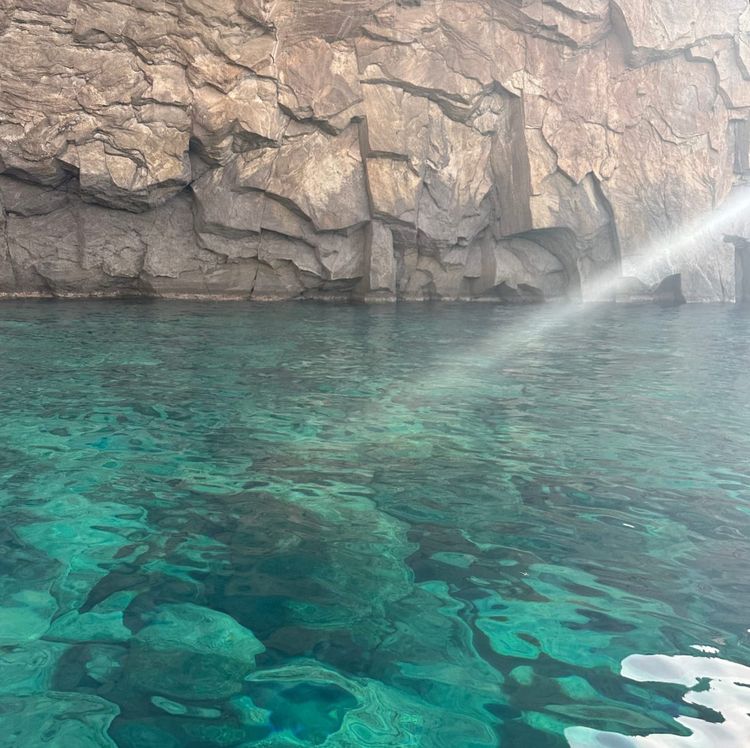
We were anchored off the south coast of one of the Egadi Islands, when I free dove to the bottom and grabbed a handful of sand just to prove I could. The water at our secluded cove is the kind of clear that doesn't quite seem real — you could see a single jellyfish — medusa, in Italian — drifting fifteen metres away as if it had been placed there for our amusement. The cove was empty. The boat rocked gently. We swam to the stony shore, sat in the sun, and didn't say much. I think about that day more than almost anything else from a month in Sicily.
Trapani, on the western tip of the island, is the town that gets you to moments like that. It's also a place worth slowing down in for its own sake — and the part of Sicily I'd send a friend to before any of the famous bits.
I covered Trapani briefly in the Sicily piece a few weeks back, but a paragraph doesn't really do it. So this is the deep dive: where to stay, what to eat, the day trip that was the highlight of the whole month, and a few things I'd tell you to do differently.
Why Trapani over Taormina or Cefalù
Both of those towns are wonderful and they're rightly on most Sicily itineraries. But they're also where everyone else is going. Trapani is out of the way — the western tip is a long way from the cruise ports and the famous postcards — and it has fewer tourists, more locals, an honest pace, and enough history packed into its old town to keep you wandering for days. It's cute without being precious. It's alive without being curated.
If you want a Sicily holiday where the photos look like everyone else's, go east. If you want one where you're more likely to be the only foreigner at the next table, come here.
Getting there: skip the rental car (for now)
We took the bus from Palermo Centrale to Trapani in early September. It's a comfortable run of around two hours, and after a week of watching Sicilian drivers do things to lane discipline that I'd previously thought were physically impossible, letting someone else handle the autostrada was a relief. The bus drops you near the port, right at the edge of the old town.
Early September is, in my view, the sweet spot. The serious summer heat has eased, the schools are back, the crowds have thinned, and the sea is still warm enough to swim in for hours. The food festivals are happening. The light is softer. Everything is a little more relaxed.
You don't need a car to be in Trapani itself — the old town is small enough to cover comfortably on foot, and the ferry port for the Egadi Islands is right there. You'll want a car for one or two days of side trips, which is easy enough to organise locally. More on that further down.
Vincenzo's apartment, and the old town
Our Airbnb was on the waterfront in the old town, in a historic family-owned building. The staircases were the detail I keep coming back to: thick stone treads built so the staircase essentially supports itself, with no visible underpinning. You don't see craft like that in many places anymore.
Our host Vincenzo took the role seriously in the best possible way. He met us at the car park, drove us around the neighbourhood, pointed out the eateries he liked best, recommended where to eat and how to book, and showed us his favourite parts of town. He waved off our thanks. This was, clearly, just what you did.
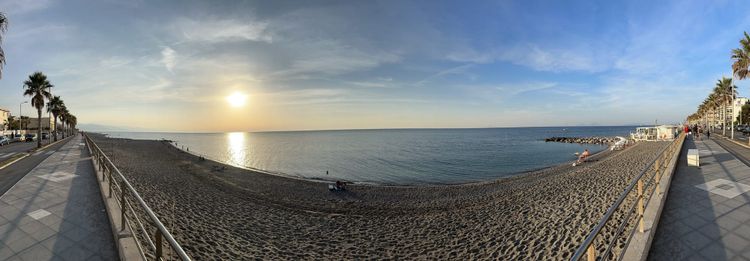
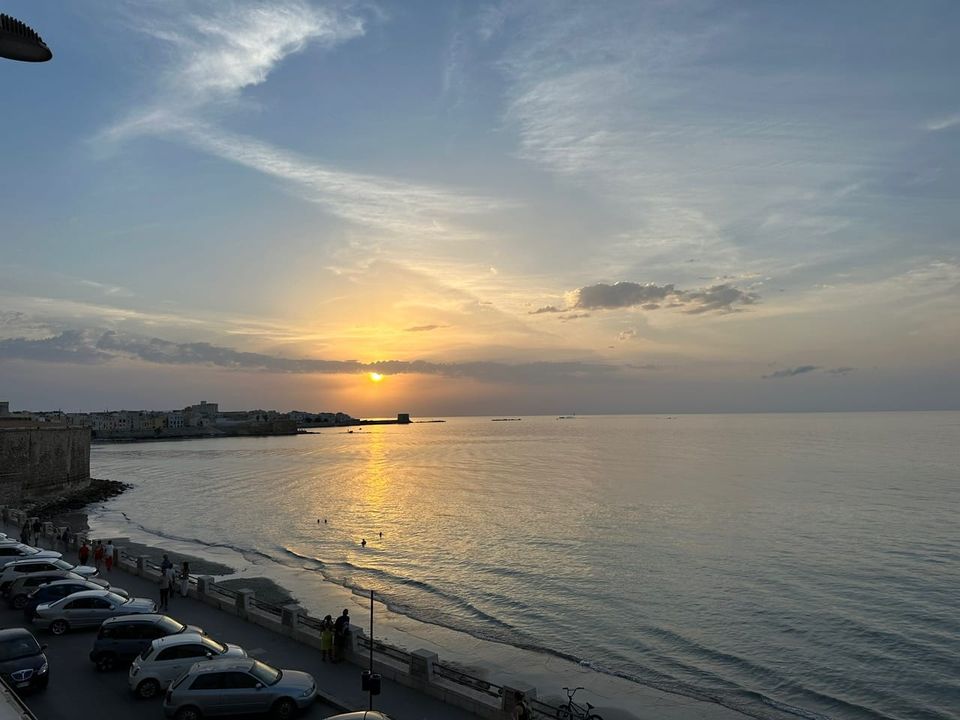
Stay in the old town if you can. The new town is fine — it's where most of the modern apartments and shops are — but the old town is where you'll want to be at sunset, when the streets narrow and the light catches the sandstone and you can see the sea on both sides from the same square.
The town's daily rhythm
A few practical notes from a week of working it out.
Book your restaurants ahead. This is the single most important piece of advice I have for Trapani. The smaller, highly recommended places — exactly the ones you've read about — will be fully booked if you walk up at 8pm. Reserve the night before, or the morning of, or accept that you'll be eating perfectly decent takeaway pizza or sitting in a more central place that's coasting on its location. The pizza was fine. The places we'd booked were better.
Eat the couscous. Trapani sits across from North Africa, and the local cuisine knows it. Cuscusu alla trapanese — couscous with seafood, often prawns and white fish in a delicate broth — is the dish to order. The famous Cous Cous Fest down the coast at San Vito Lo Capo runs in mid-to-late September, and the whole region leans into it that time of year. We didn't make it down for the festival itself, but the dish was on every menu we cared about, and it was reliably excellent.
Find Gelateria Liparoti. Walk out toward one of the points and look for it. We went the first time for a regular gelato and got food envy watching the table next to us eat something we couldn't identify. I asked, in the best Italian I could muster at the time, what it was. The answer was caldo e freddo — literally "hot and cold" — gelato with a glossy hot sauce poured over the top so the contrast becomes the whole point. We ordered one immediately, despite having just finished our previous order, and went back for it again the next day. It is, without exaggeration, one of the best desserts I've had anywhere.
A square, a bar, a passeggiata in the evening — these will find you. Trapani is small enough that the rhythm sets itself within a day.
A drive to Erice
You can see Erice from Trapani — the medieval town perched on a mountaintop, often wrapped in cloud. The cable car runs from a base station near the autostrada and is the easy way up. The day we tried, the wind was too strong for it to operate, so we drove. Two pieces of advice if you do the same.
First, park as soon as you find a free spot in the lower car parks. Do not, under any circumstances, attempt to drive into the historic centre of Erice. The lanes are barely wider than a car, the ZTL — zona a traffico limitato, the restricted-driving zones — are aggressively enforced by camera, and a wrong turn can earn you a fine that arrives by post six months later. Walk up. It's not far.
Second, stay for sunset. Pull up a chair at one of the cafes with a view, order something to drink, and just wait. The light over the western coast and out to sea is among the best you'll see in Italy.
While you're there, find one of the historic pasticcerie. Erice is famous for its marzipan, and what they make up there — small almond-paste fruits, miniature pastries, intricately constructed sweets — looks like jewellery and tastes better. Maria Grammatico rightly earns its reputation.
The salt pans and Marsala
We did the salt pans and Marsala in a single driving day, and it's a good combination if you have a car for the day. The Saline di Trapani run south along the coast — shallow rectangular pools of seawater, divided by low banks, with old windmills standing over the brightest pans. We stopped at a working salina and learned how the salt is harvested: how the sun and wind do the work, how the colour of the water tells you how concentrated it is, how the piles of finished salt sit blindingly white in the afternoon sun. It's quietly remarkable to see something so old still being done so simply.
Marsala the town is half an hour further south. The wine deserves more attention than it gets. The history is sobering — Allied bombing in 1943 destroyed much of the town and the cellars, and most of the Marsala houses you can visit have been rebuilt or re-established once the war ended. We did a tasting paired with food (the cellars are set up for it; you don't need to be a wine person), and what surprised me was the range: bone-dry to dessert-sweet, young to decades-aged, all of it more nuanced than the reputation Marsala carries internationally.
The Egadi day, properly
This was the day the trip earned itself.
The Egadi archipelago — Favignana, Levanzo, Marettimo — sits a short hop off Trapani's coast. You can do them on the public hydrofoil (Liberty Lines runs the route from the port; it's quick and cheap and works perfectly well). But if you can, charter a small boat with a local driver instead.
Our friends, who knew the area, organised it for us. Five of us paid €150 between us — about €30 each — for a full day with a driver who knew the islands, knew the wind, and knew which coves would be sheltered on the day. He was young, calm, and read the conditions constantly. The chartered approach gives you something the hydrofoil can't: flexibility. Stops where you want, lunch where you want, swimming where the water is clearest and least crowded on the day.
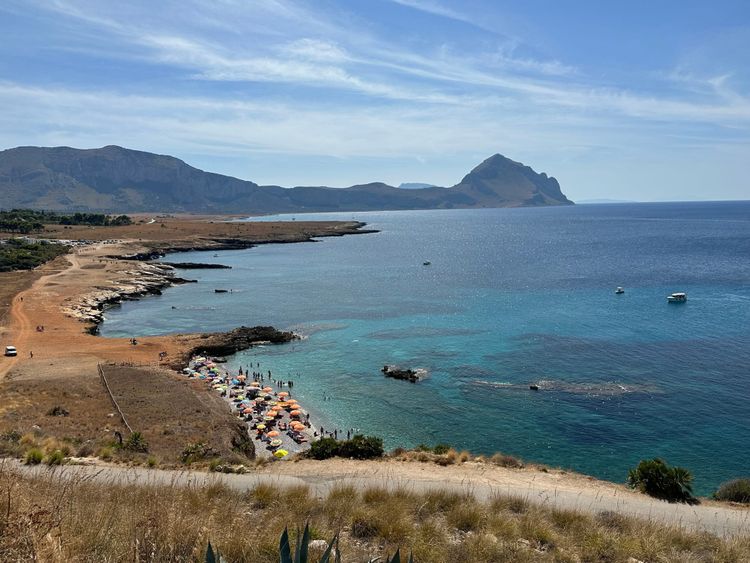
We went around Favignana first — the south coast is where the famous coves are, and Cala Azzurra is the one I'll never forget. Lunch was in Favignana harbour at whichever place looked best when we tied up; the swordfish was extraordinary, the prawns were fresh that morning, and we ate slowly. We drove past the tonnara — the old tuna fishery on Favignana, now a museum — and on to Levanzo and Marettimo, where the beaches are quieter and the towns are smaller and the pace drops another notch. The water at every stop was the kind of blue you remember.
If you can't arrange a boat through someone who knows the area, GetYourGuide and Viator both list day-charter operators out of Trapani who do something similar — you'll pay more than €30 a head, but the format is the same and the day is worth it.
The wind
It earns its reputation. The western tip of Sicily catches everything coming off the open Mediterranean, and on most of the days we were there it blew steadily — not unpleasantly, just present. Mild and warm on land. Strong enough most days in that week to close the Erice cable car and to send the umbrellas at the seafront cafes sideways. We didn't change a single plan because of it. We just enjoyed it.
The Honest Version
A few things I'd tell a friend.
Don't underbook. Two nights is not enough. Three is workable. A week is what we did, and I could have stayed longer without running out of things to do. The town rewards a slow rhythm — eat, swim, walk, repeat — and the day trips need a day each at minimum.
Take the bus from Palermo, hire a car when you arrive. The bus is calm and cheap; renting in Palermo and dragging a car through three days of Palermo traffic is unnecessary punishment. Pick up a car in Trapani for the Erice and Marsala days, drop it back, and walk for the rest of your stay.
Listen to locals. Vincenzo's recommendations were better than the guidebooks. So were our friends'. If a trapanese tells you to book ahead, book ahead. If they tell you a place is a tourist trap, believe them.
Go in early September if you can. Late summer warmth, thinning crowds, the Cous Cous Fest happening down the coast, the sea still swimmable. October would also be lovely. Avoid August unless you like queues and heat.
Don't skip the islands. If you only have one full day for a side trip, make it the Egadi.
Nothing about Trapani disappointed us. That's a rare sentence to write about a week of travel.
Why this corner of Sicily
The pull of Trapani isn't a single big-ticket sight. It's the cumulative effect of a town that's still mostly itself: a port, a working fishing fleet, salt pans down the coast, a mountain town up the hill, three islands offshore, and a kitchen tradition that pulls from across the water. It rewards the kind of traveller who'd rather sit at the same gelateria three afternoons in a row than tick off ten "must-sees" in a week.
That's the whole pitch for The Quiet Road, really. This is a place that fits.
The Quiet Road covers regional Victoria, Tasmania, Italy, EV road trips, and the food and wine that connects it all. Subscribe to the newsletter for one recommendation every Friday.